Wednesday, July 15, 2009

What no fall garden plans?

Quick, pull those garlic bulbs and throw down some brassica seeds - you know chinese lettuce, kale, turnips. Or maybe clear out that spent pea patch and toss in some heat tolerant loose leaf lettuce or some carrots. It's time for the fall garden preparation.

Photobucket
Lettuce and mustard, both prefer growing in cooler weather.

I know what your thinking. You started the season off with a gusto. The garden edges were neat, the beds weedless but now your a bit more relaxed as you sit in the garden with your choose of cool beverage watching the tomatoes ripen. So what if there are a couple dandelions in bloom around the edges. You like dandelions. Besides, your back is still aching from all that shovelling in the spring.

So you'll be happy when I tell you that planting a fall garden is as easy as 1.2.3

1. Look for some quick growing, cold/frost tolerant plant seeds at the bottom of your seed box. Think cabbage family members, greens and root crops. Don't forget plants that tend to bolt when the hot weather hits like florence fennel.

2. Go outside and find a bare patch of ground or clear away some plant debris from old flowers or vegetables. Toss those seeds down.

3. Make sure you water frequently, especially in the heat of summer.

Done.

Now, if you remember, do some weeding and thinning for optimun growth but if you don't, you might next year after you see the results. Some time in September, your tomatoes will feel the sting of frost. Beans and pumpkins vines will be shrivelled brown revealing behind them a sea of green. Radicchio will be forming crisp red heads. Lettuce will splay out in fans and tightly coiled buds of broccoli will be raising on the ends of thick stalks.

The season will not be over for you. Using a coldframe or some simple plastic tents (I'll elaborate another time but google season extension), you can keep out the bitter winds and those first dustsings of snow too extending your harvest even longer.

So what are you still doing sucking back that cold one? Go find some arugula seeds and sow!

Monday, July 6, 2009

Another cool pepper trick

Photobucket
Garden expansion via large pots or why scrounging stuff from your neighbours is good. All my mini and hot peppers are growing in pots that were donated by my neighbours who put in a cedar hedge.

Early in the spring, a terrible thing happened: Cutworms ate through the stem of my variegated pepper. The previous fall I had resuced the seed for this pepper from a fruit dropped by a 'Fish' in their demonstration vegetable garden. I patiently dried the pepper and separated the seeds wondering if it would come up variegated like its presumed parents. It did beautifully until one fateful day.

In a desperate move, I stuck the broken stem back into the soil and kept it watered. My theory was because it was related to tomatoes, maybe it would too would easily root along its stem.

It took!

Photobucket
Fish pepper plant working on life 2.

My pepper plant survived. No, it will not produce peppers for me this year but as I commonly overwinter my favourite peppers, I have hope that next year, I will see the fruit of my labours.

Just a reminder that gardening is for the patient.

Monday, June 15, 2009

Flowering Food - pink

The food is starting to flower fast and furious. Not only is chicory and bietina in bud (type of chard that can have perennial tendancies) but sorrel and rhubarb are almost in seed. I am looking forward to seeing mallow and daylily next according to the schedule.

Amoung the pink flowering edibles I spotted today are Rugosa Rose with edible petals and plump, colourful hips in the fall. Here shown with edible spiderwort or Tradescantia virginiana , possible a hybrid though and if so I'm not sure of its edibility. Another google project.

Photobucket
Rugosa rose in bloom with spiderwort.

Yellow, edible podded pea with pink / purple flowers is growing up a bamboo stick trellis in the middle of my circular veggie garden.

Photobucket
Lovely purple blossoms promise golden peas.

Poppy mallow, or Callirhoe involucrata, has a beautiful fushia cup flower. Its leaves are edible, as are its roots which are rumoured to taste like sweet potato. I haven't tried them yet as I just planted it this year. I have some started from seed but they are about an inch high. This one was purchased at a nursery but I really shouldn't have cleared them out of poppy mallows as the next time I went to get some more, they were all gone.

Photobucket
Poppy mallow meandering around the front garden bed. Conditions are hot and dry, perfect for this plant. Planted here with some cabbage seedlings... we'll see how they do. It's their rotational turn in the less than perfect conditions for growth.

My rattail radish is in bloom though it did not have the purple and white blooms I expected, more pinkish and white. The plant also bolted very young but that's not surprising in the crowded, dry and hot conditions under which I planted it. Here are some blooms shown with rose campion leaves in the background:

Photobucket
I'm intrigued by a radish with spicey pods, especially as I'm not a fan of its roots.

Looks like my Salad Burnet or Sanguisorba minor is going to flower this year too. Its leaves are supposed to taste like cucumber but I'm not really convinced. It is grown here with some truely tasty plants including orach, mallow, and chicory. I also just noticed the pink tinged petals of english daisy or bellis perennis - another edible plant.

Photobucket
Salad burnet in the centre, just about to flower.

Sunday, June 7, 2009

Flowering Food - Bunchberry

Bunchberry

Photobucket
White flowers of bunchberry have invaded a pansy (edible petals*), that has overwintered several years running, to make this bouquet.

Cornus canadensis is a northern north american native with a span from east to west. It is a forest dweller, forming thick carpets of four petaled dogwood flowers in late spring to early summer, followed by edible berries. To grow well, it needs acidic soil that doesn't dry out. Not only do I know this by reading, but I have this on authority from the local expert on natives at the Native Plant Sale at the Wildlife Fletcher Garden that I attended yesterday. We had this conversation:

Plant Expert (talking to another customer, I'm just snooping): It really needs acidic soil to do well which is probably why you haven't had success with it.
Buyer: Oh, well yes.
Plant Expert: I haven't had it work either.
Me (butting in): I have bunchberry that grows well in my soil though it's pretty nuetral.
Plant Expert: Is your soil sandy?
Me: Um, yup.
Plant Expert: The conditions must be good enough that it is overcoming its requirements. If you had it against the foundation with all that lime leaching in the soil, it probably wouldn't do well.
Me: Hmm. Guess some plants surprise us with their tolerances.

Me (thinking to myself): Actually, it is against the foundation. Oops.

It is planted on the north side of my house (against the foundation), in a bed heavily enriched with leaves, many of which are the acidifying oak leaves so maybe I have managed to acidify the soil at least locally though when I infrequently check the pH, I find it nuetral. My friend gave me the bunchberry with the warning that it spreads. He has his planted near the house foundation as well though he also has an evergreen nearby which might be helping in the acid department.

Back to the berries. They are described as suvival food which should give you a good idea of their palatibility or lack thereof. I like to give them the more flattering description of children's berries as children seem to overcome their ick factor in the garden and eat anything that won't kill them. Anyhow, they are pretty, grow in a woodland setting, are native and have bland but acceptible taste. If you have acidic soil, they make a nice ground cover.

And another thing:
More on the Native Plant Sale

I didn't manage to come home with too many edibles this time as the Viburnum cassinoides or Wild Raison was walked away as I was about to pick it up, but I did get a number of lovely natives including tall sunflower, pearly everlasting, bellwort, prairie smoke, canadian wild ginger (root edible), blue stemmed goldenrod, st. john's wort (bushy, I think), nodding onion (also edible), and a plant whose name I can't remember... oh yes, it was a wild time.

I highly encourage anyone interested in creating an eco-friendly garden to check out this sale next year. Also, go to the gardens, as they have an beautiful example of an urban garden using entirely native plants behind the information building, along with a butterfly meadow, forest walk and amphibian pond. It is pretty accesible for strollers as well.

* Pansy petals are edible but be careful when trying any new food, especially if you have allergies to pollen, or a similar plant. Avoid the pollen producing parts to be extra safe. That said, I have never had a problem gobbling edible flowers.

Tuesday, June 2, 2009

Flowering Food: Kale

Not only is kale good for you, and by that I mean tasty, but it also works to give long season interest in the garden, still sitting pretty in the snow. Its thick leaves range from silvery green to purple, from softly waved to crinkled or puckered, and contrast well with finer foliage. Tall specimens like Dinosaur kale give an almost tropical look with large frond like leaves. The dwarf kinds like Blue Curled Scotch act as neat border plants the first year and in the second year, send up stalks of yellow flowers early in the season. You can choose to eat these flower heads before they open, much like broccolini but please let a handful flower*. Not only will you be rewarded by this floral delight, but all going well, you'll have a carpet of little kales waiting to take their biennial parent's place.

Photobucket
Red Ursa kale in flower.

* For genetic vigour, plant a variety of kale and let at least 10 go to seed. (I'm just bluffing on the number but it's more than 5 and less than 50. 10 is the number I try to have to go to seed but on bad years, it can be fewer. A fellow blogger saves cabbage seed from as few as three surviving heads so fear not! You can always add to your genetic stock by planting new varieties and letting them cross with your old ones).

How to grow kale

Why not trying winter sowing it? Some time in the depths of winter, take a break from browsing those garden mags, and throw some seeds in a mini greenhouse made of a recycled container (huh? Go to the site, you won't regret it) then let nature do the work. By mid-spring, you should have a kale plugs all ready for planting out.

Alternatively, you can start them around the same time that you start tomatoes, only put them outside when the weather is still cool even if mild frosts can be expected. Around here, I start mine around mid-March to early April and plant out sometime at the end of April to early May. If I plant out when snow still threatens, I use the tops of pop bottles as mini-cloches to create an enhanced growing environment.

You can also direct seed your kale mid-summer for a fall, even winter, harvest. They make good coldframe crops.

When the seedlings have a couple true leaves, you can carefully transplant them into their final spots. The rules of rotation recommends that you don't plant them in the same ground as another member of the brassica family more than every 3 or 4 years. Though less fussy than cabbage, cauliflower or other brassica aristocrats, they do appreciate a side dressing of compost or manure along with a steady water supply. They will also tolerate part shade.

With any luck, they will overwinter giving you broccolini, flowers and baby kale.

Photobucket
Dwarf Blue Curled Scotch kale hanging out with brassica buddies brussel sprouts and chinese cabbage.

Monday, June 1, 2009

Flowering Food: Rhurbarb

My interest in edible landscaping has lead me to look more closely at the food plants that I grow not merely for how they affect my palate but also how they strike the other senses especially sight. And with an eye on appearance, let me present the rhubarb flower*:

Photobucket

Just like in perennial flower design, you can help your plants stand out by contrasting foliage. One of the most effective methods of balancing out green sea of medium sized foliage plants is by adding coarse and finer foliage. Rhubarb is a spectacular plant with huge coarse leaves. The red viens of some varieties are also striking. Other edibles with coarse foliage include most members of the brassica family such as seakale, collards, horseradish (I will have to write a different post singing the praises of this so-called weed), and the beet family with the most impressive, from a decorative standpoint, being the chards. If you live in warmer climes, you can include globe artichoke and cardoon as perennials. Some brave northerners grow these annually and I have considered trying to overwinter giant pots of them in my garage but I haven't gotten up the courage or time.

Photobucket

* Some people recommend cutting off the flowering heads of rhubarb to redivert energy into the production of leaves and stalks. I do this erratically and my plant hasn't suffered yet. In fact, the thing is huge - 4x4 feet huge. It is a green stemmed variety but oh so tasty.

Sunday, May 10, 2009

Eat my front yard (well not all of it)

My project this year is to replace any plant not worthy of its dirt. Priority is being given to perennial edibles and natives but I'm allowing some ornamental frivolity like my Hellebore which I can't part with. Recent additions to the front yard harvest are:

Callrihoe involucrata aka Poppy Mallow: A plant for a hot spot, you can eat the leaves, flowers and root which is supposed to taste like sweet potatoes. I bought a single plant and am trying to germinate some seeds - trying, very trying. I'll need lots of plants if I plan on tasting this root.

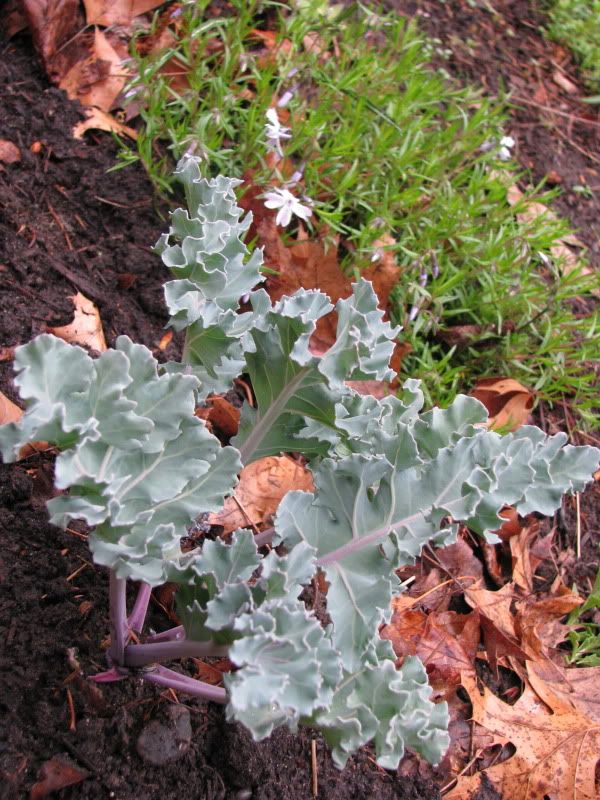
Crambe maritima aka Seakale: A perennial brassica relative traditionally used as a blanched shoot in the spring but the coarse leaves and flowerbuds are edible too. I bought a couple with purplish leaves but my two 'Lily White,' with green leaves, finally showed their heads. I've also seeded Crambe cordifolia from a kind seed giver in Europe though I'm not sure of its palatability.
Photobucket
Seakale

Rumex sanguineus aka Bloody dock: Yet another carrier of oxalic acid, more commonly known as 'spinach substitutes.' I wanted this one because it is a short plant with rough textured red veined leaves suitable for edging.

Tradescantia virginiana aka Spiderwort: I evicted my Mountain Bluet for this plant which besides being native is supposed to have edible leaves. We shall see...

Borage officinalis aka Borage: The spiderwort is sharing its spot with Borage. I have a thing for blue flowered plants. It's supposed to taste reminescent of cucumbers. I also have salad burnet - another 'cucumber' leaf plant but I've yet to taste the cuke in it.

Opuntia aka Prickly Pear Cactus: My 3 year old daughter was very excited to see that I had kicked out 'The Pearl' Yarrow in favour of this plant. So excited that after saying 'Look, a cactus, look, look,' she ripped it out of the ground and carried it to us to have a better look. I'm not sure if I will ever try to eat the fruits but I wanted to know how it grows and I, like my daughter, think it's fun to grow a cactus outside in the north.

Allium tricoccum aka Ramps: At a local plant sale, I had this discussion:

'Is this plant labelled Wild Garlic Allium tricoccum'
Plant seller: 'I don't do latin.'
'I know what you mean, just happen to know this one. It's useful when you're talking internationally. (Trust me, I really can't rattle off the latin names most of the time unless of course I'm totally obsessed in finding a plant like this one). Is it the wild leek?'
Plant seller: 'You're not supposed to pick it. This comes from our property.'
'Oh yeah, it's Allium tricoccum then. I'll be happy to set up a new colony on my property for the purposes of protecting it.'
Plant seller (has his latin sheild up): 'Yeah, my wife does the latin.'

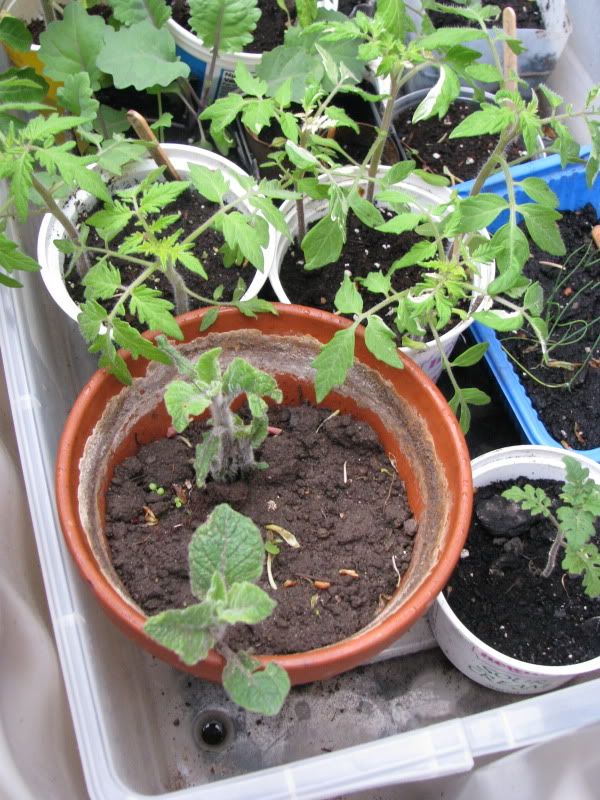
Physalis heterophylla aka Clammy Ground Cherry: The most exciting find of all - the perennial ground cherry. La la la la, happy day. At the above plant sale, I asked if she had any of that self seeding ground cherry she wrote about.

Plant seller: 'Don't know if it's come up yet. Oh, yeah here it is.'
'Those look like perennial shoots.'
Plant seller: 'Yes, it's perennial.'
'It's edible right, sweet?'
Plant seller: 'Yes, quite good.'
Photobucket
Ground cherry in the clay pot looking a bit like it's evil cousin Chinese Latin. This one is fuzzy.

I look closer, OMG, it's clammy ground cherry. For those in the know, I'm getting excited over a weed but I have wanted to try this plant for some time now. Must stop hyperventilating.

Prunus tomentosa aka Nanking Cherry: Cute, fruiting shrub which I understand I have to wrestle away from the birds.

The Ribes clan aka More gooseberries, josta berry, currants white and red: A very generous fellow edible plant enthusiast at The Green Igloo blog gave me several gooseberry and currant bushes to add to my burgeoning collection. My kids love these tart little fruits that rarely make it past the threshold of our house but are eaten out of hand in the garden. She also gave me some raspberries which are Rubus if you're latin shield is down.

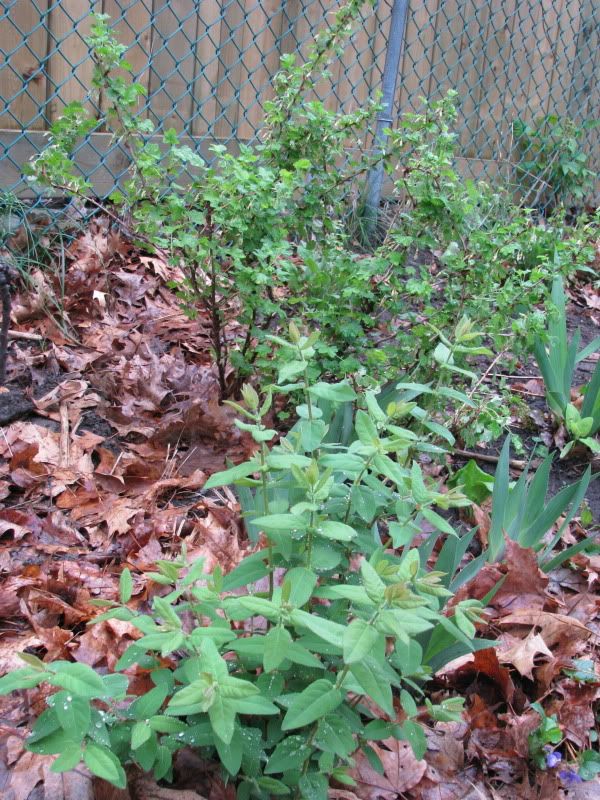
Fruiting Honeysuckle / Honeyberry: A plant with a reviews ranging from 'bumper' to 'bummer.' After reading the hype on DNA gardens, I figured I would try it myself.
Photobucket
Honeyberry front and centre with a Ribes bush, maybe currant, behind it.