As requested, here is a post on front and centre edible gardening.
My old front yard had a large spiral garden planted with herbs, perennial edibles, ornamentals and fruiting trees and shrubs. If you followed the spiral to its centre, a small stone bench awaited beneath a grape vine (not pictured here - instead peas climb up the trellis).
Tired of the growing green cement in your front yard? Or perhaps you have thriving perennial beds but have run out of space to plant veggies? Maybe it's just that the only tomato growing sun is in the front?
Ever watch a kid interact with a lawn? If they are not spinning in circles or kicking a ball, they gravitate to the bushes and flowers at the edges or search out the weeds. The 'yawn' becomes a blank palette on which the eye searches for interest. Why not paint boldly.
Well then what's stopping you from growing your food for all to see?
Here is a formal decorative vegetable garden before planting at the Museum of Agriculture. It's not messy but it is terribly boring early in the season and requires some pretty diligent weeding to keep up those bare spots. Orderly shapes compliment the sometimes rangy growth habits of vegetables but without anything at all growing they are merely geometrical.
The biggest issue is that people worry that veggies are messy. Because we view food as coming from utility plants, we have a hard time imagining them replacing the frilly fancies that normally dot the front. Not to fear. In this case, you can have your blooms and eat them too. There is more than one strategy to add edibles to your front yard.
Some purists only plant what enhances the garden's ability to make food either because it's a cover crop, a trap crop, habitat for friendly bugs or because it's food. Others add the odd veggie here and there among their flowers and still others prefer more prescriptive approaches such as
forest gardens1 or
decorative potager. There's no right way but here are some design tips to help with curb appeal.
Bones
The visible skeleton of my old spiral garden that faced south though was variably shaded by a beautiful old Linden and a red oak in its prime. The main paths were stone inlaid with old pavers, secondary paths were lined with blasting stone and wood/leaf mulch that was also applied around the perennials. Compost and manure completed the top dressed amendments.
Just like designing a purely decorative garden, structure will keep the garden looking organized even in the early spring before perennials have popped up their heads or bedding plants have been tucked in. There are two main types of bones: hard structures like paths and arbours and woodies like bushes and trees.
In the beginning... Some softer bones in the form of fruit trees. I got these in the ground before I built the rest of the garden around them. The bush in the middle was removed and replaced by the stone bench and a grape vine but the three trees remained: two apples and a self fertile plum. This picture gives a sense of the large swath of south(ish) facing lawn that once graced the front yard. By the end of our stay, it had shrunk to a bit less than a third of its original dimensions.
Especially if you are planning on growing a lot of typical annual vegetables in your front yard, you'll want to have an attractive, strongly structured shape to your garden to give eye-appeal even if the beds are empty and to offset the often rangy growth habit of veggies. Start by looking at the shapes and structures already present: dimensions of your house, the shape of your yard, any standout features like rocks, trees etc... Even less noticeable features like a slight dip can be taken advantage of and enhanced.
Next ask, how do you use your yard? Do you like to sit out front and watch the world go by or would like to make it a bit more private (without blocking lines of sight for drivers, pedestrians and cyclists of course). What is the most common route that you take across it? This will help define the main path and any additional features you'd like to add such as a bench.
I love how little care I seem to take in staging pictures (she says sarcastically). The knee pad is a nice touch in this client's garden where a stone and mulch path leads from the front door to the back. Along its edge is a healthy row of kale. This client requested an entirely raw, edible garden. Kale chips were a favourite.
Note the shape of your yard and start breaking it apart in the mind's eye. Inside a square, a circle can be drawn and then a garden placed either within or at the edges. Structure can also be provided by more naturalistic shapes such as curves. Trace them out with a line of flour, a hose or by doing the dotted line - my usual technique. I turn over clods of sod along the line and then examine it at all angles to decide if it has the right affect. Be bold. Just remember you will need access paths approximately ever four feet both for maintenance and so you can wander around your paradise admiring the small details.2 If dealing with the whole yard seems daunting at first, focus on a feature such as a bird bath or existing garden and build outward from it.
I am a big believer in four seasons of fun gardening. Though during the white one, it's mostly playing in a polytunnel. Therefore, I plant lots of spring flowers and early risers along with edible perennials that give tender shoots shortly after the weather warms like Hablitzia or asparagus. If you prefer, you can go native. The same holds for fall when I love late flowers like asters combined with the glorious seed heads of amaranth and the violet blues of cabbage.
Also giving year round structure are the woody plants such as fruiting trees but don't discount evergreens. Though not as edible as apples or currants, their branches can be clipped to shelter other plants and they provide long season interest.
As the season wears on, the spiral is less obvious for those not walking it and the textures of plants emerges. This garden is as bursting with things to eat as to look at and smell. See list below.
Mature fruit trees often have beautiful natural shapes and liven up spring with their short lived flurry of blooms but various pruning techniques can limit shading such as
splaying the branches against the wall or making stopover trees so that more plants can be grown around them.
Canadian Organic Gardeners maintains a little herb and veggie patch at the Museum of Agriculture. Here they have rhubarb and currant underplanting apples if I remember correctly.
Another alternative is the hedgerow. Generally a wild, mixed, woody boundary or living fence.
Hedgerows are not just attractive but provide food and shelter to wildlife and yourself.
Not Just Herbs: Edible Perennials
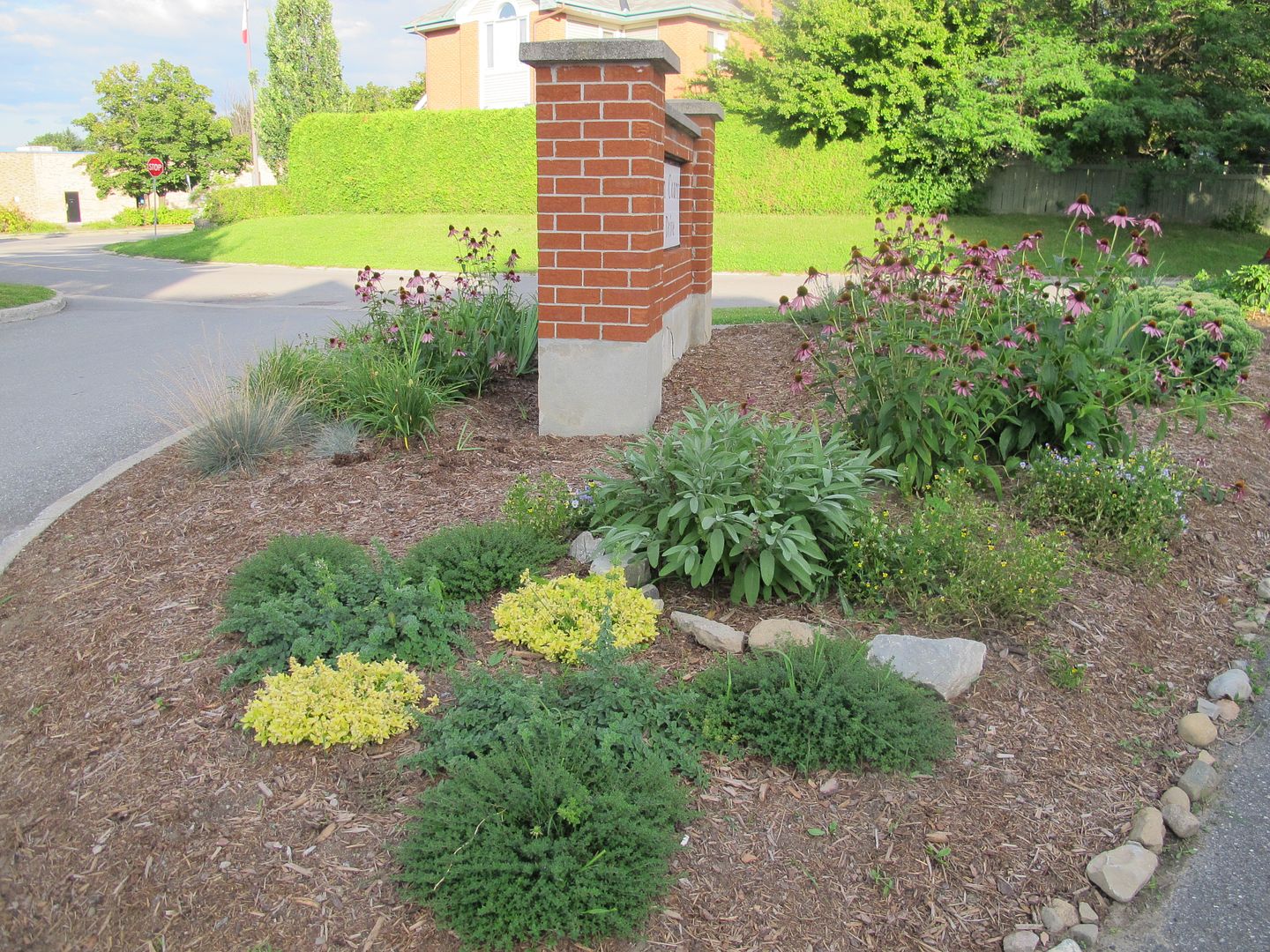
Here are 'just' some herbs: sage and oregano planted in the dryer, sunnier part of the garden.
Not that I want to discount the beautiful flowering herbs like catmint, lavender, sage, oregano, and thyme but I'd like to include less well known edible herbs like lovage, sweet cicely, garlic chives, mondarda, and sorrel. For those who have not yet investigated, the list of perennial edibles is surprisingly long including well known favourites such as daylily and hosta (yes, the early spring shoots that
Stephen - edible plant collector extraordinaire - calls hostons), natives like prickly pear and strawberries and other favourites such as asparagus and perennial onions. Many of these are very attractive plants that are not out of place in a decorative garden.
Needing careful placement, this towering giant among useful perennial edibles - Jeruselum Artichoke - was put at the side and back of the garden in its own bed as it is seasonally dug out. By being kept to the back, its absence in spring and fall are not so noticeable nor is its presence too foreboding at the height of its growth. Instead it is a lovely backdrop. P.S. If you tend your garden, rumours of its invasive nature are at least slightly exaggerated in my opinion in our climate. If you do not spend your days lovingly coddling your plants then you might forget a patch long enough to require few years of diligent removal. Radix Rhizowen recently made a discovery when trying to eradicate a patch with landscaping fabric. The forced shoots are quite tasty.
The list of edible perennial plants is surprisingly long and they are often beautiful. In fact many plants started their history as useful only to be converted to decorative along the way such as balloon flower and bloody dock.
One of my favourites: Sweet cicely - all parts edible tasting like sweet anise - lines the partly shaded path toward the back, grown with clematis and alpine strawberry, mallow and iris.
Ringing your annual beds with compact, short statured herbs is not only useful but also acts as another reliable feature around the rangy pumpkins or potatoes. Having lots of diverse flowering plants will also feed beneficial insects and confuse the signals pests use to find their host plants. Breaking up plantings slows the spread of disease too.
Sperling toga onion underplanting Nanking Cherry.
Perennial/walking kale currently is continuing its winter hardiness trial in my garden, backed by the flowers of the spready Dame's Rocket (edible and not bad).
Decorative with Edible?
There is no law that states that you cannot grow peppers near Dahlia or Coreopsis.
In early summer, this garden is alive with iris along with orach, lemon balm (ack - that's one that you shouldn't let seed), malva, salad burnet, strawberries, elderberry, lovage, young currants, Bellis perennis and more.
Turn the rules of design on your edibles to make something pretty and functional, ex. compare and contrast, don't put your sweet potatoes near something that doesn't like root disturbance. A well mulched perennial bed with plants carefully chosen to thrive in that garden's conditions can be pretty low care.4
Cabbage in the background facing the street and lavender in the foreground playing off cabbage's bluish leaves.
That's not to discount annuals. Many people add bedding annuals such as marigolds to look at and to ward off pests. When incorporating temporary plantings, make sure that everyone has enough space to do their thing though as sometimes annuals can suffer next to well established thugs.
Salsify was grown here as a self seeding root crop. Here their early morning glory is echoed in the giant purple alliums.
Classic annuals
Dark leafed elderberry (not convinced by this cultivar as a fruit crop by the way), is threaded by bicolour runner bean.
Mixing it up with annuals and biennials will mean that you disturb the beds more either by exposing ground for seed or transplants and to harvest or remove debris. Some good places for annuals are the border edge especially for greens and root crops before they go to seed, spaces between young perennials and dedicated annual pockets.
A dedicated annual planting pocket that was soon overgrown with tomatoes. These spaces can be rotated. If rotation and perennial planting sounds confounding, here's my exploration of the subject.
Don't forget that you can embed pots around the garden too. Having the pot in contact with the soil and surrounded by greenery may keep them moist longer.
These two habanero peppers were placed on the ground and abandoned while I traipsed off to visit relatives for a month. I was happy to see them alive when I returned. The rain must have cooperated.
There are plenty of colourful edibles such as rainbow swiss chard, purple leafed beet, golden anise hyssop, amaranth and eggplants, and others that are texturally compelling such as feathery leafed carrots and parsley, glaucous cabbage and kale or strap like chufa and salsify.
Some texturally interesting plants seen head on including soft leafed orach, the whirl of salad burnet, and the increasingly fine dissection of the malva leaves. I love, love Rhubarb as leaf plant. It is particularly nice paired with rainbow swiss chard and nasturtiums.
In keeping with decorative, veggies should be neat and by that I don't necessarily mean in orderly rows or blocks though that's an option. Make sure their best features show by removing diseased leaves and growing sprawlers up. I can see how peas intertwining through a shrub can be beautiful but otherwise, you'll want to trellis vines with something that doesn't say utility.
The Museum of Agriculture's potager (shown above) late in the season with some type of dwarf, upright pepper and the edible designer's darling: rainbow swiss chard. Note how the tomatoes on the trellis are looking very scruffy.
Just like in regular garden design, keep large plants to the middle or back of a bed. Some vegetables will look sickly before harvest is finished such as tomatoes and squash that tend toward foliar disease. I wouldn't put these front and centre if you are going for maximum eye appeal. Others that will be harvested early can be replaced with a second crop or bedding plants.
Self seeding annuals
Yes, it's a fav: orach. That's the bright red one, along with osaka mustard and red ursa kale. Perennial onions spiking up in the background. These were all self sown.
Lots of edibles such as chicory, oyster root, magenta spreen, amaranth, and kale will give you a second, third or more harvest from an initial planting if only they are left to go to seed (which may not be until the second year). There are two problems. One is that a tidy, ruby head of radicchio placed at the front of the border can become a four foot spindly giant the following year. If you are planning on letting them go to seed, keep their final height in mind. You may want to plant diagonal swathes, removing those in the front and letting those at the back do their wild reproductive thing. The flowers will add to the diversity of your garden.
Yes, this is my old backyard and I actually think these bowing heads of parsley preparing to invade my yawn are cute but you can see the problem. P.S. They are leaning on what used to be my veggie patch. It was reconverted to lawn for sale. Apparently people like lawns?
You may want to bend seed heads toward where you'd like them to travel or cut and lay them down in a new spot. The other issue is that if you heavily mulch then you may get few reseeders. For this reason, I used to do my main mulching before reseeding (depends on the plant and the mulch, how well they'll do seeding into mulch) or after the volunteers are up and thinned in the spring. One easy way to rejuvenate an area is to stir the top few inches soil in spots near where plants have gone to seed.5 When I replaced my vegetable garden with lawn before selling, I just spread out the dirt and sprinkled some grass seed. What emerged was a swatch of salad greens germinating alongside the grass and clover.
And with that we come full circle.
What grew in the front?
Below is just what I remember growing in my old front yard that was edible. It doesn't include all the great stuff in the backyard or all the possibilities. At my new place, I'm going totally wild (in a so much space, so much choice kind a way!)
Currants
Gooseberries
Jostaberry
Hostas
Chives
Garlic Chives (eat the flowers or you'll have lots)
Daylilies
Strawberries - pink, white flowered and alpine
Apples
Pears
Cherries
Blueberries
Horseradish (near the back)
Jeruselum Arichoke (near the back)
Yarrow (marginal!)
Oregano
Sage
Thyme
Lavender
Mint (yikes!)
Mitsuba - purple leafed
Salsify
Scrozonera
Red Valerian - not bad in the spring
Violets
Violas
Rhubarb
Borage
Spiderwort
Rugosa
Crosnes
Hosta (spring shoots)
Solomon Seal (spring shoots)
Grapes
Seakale
Prickly Pear
Strawberry Spinach
Bloody Dock
Calendula
Trilliums (shoots) - no I couldn't eat them, too pretty
Bellis Perennis
Bellflower(s)
Balloon Flower
Sedum (check varieties)
Cinammon Yam (didn't like me)
Perennial Leek
Ox-eye daisy (marginal according to me)
Raspberry - not for front yards me thinks - moved.
Rugosa rose
Various edible flowers and tea plants: catmint, monarda, hibiscus, dianthus and so forth
Mustard
Celeriac
Peas
Peppers
Eggplants
Sunberry
Kale
Nasturtiums
Cabbage
Lettuce
Garlic
Landcress
Sunflower
Corn
Cucumbers
1. Seen as belonging to a much wider gardening (and increasingly lifestyle) practice called permaculture, this link takes you to a man who popularized the term forest garden.
2. My spiral garden was planted in part to obscure the path in order to invite people to walk its distance. It was challenging planting for height in the middle of each bed but also graduations as you moved toward the centre, from front to back AND from the house to the far side. Also, I wanted lots of little features that could only be seen up close. I enjoyed making it!
3. Double-check their info for your own peace of mind and remember whenever you try something new, go slow! I find that their hardiness ratings are sometimes off. They are located in the UK so growing info is skewed to that climate.
4. I would feel remiss if I didn't mention that certain plants can affect each others' growth negatively or positively. These interactions aren't always so visible especially if the plants are in a rich garden environment where they can compensate for slight insults. However, the classic example would be the strongly allopathic affect of black walnut that inhibits the growth of certain plant families such as tomatoes and their kin.
5. Seeds have different longevities of course and weeds also inhabit your seed bank which is why some people are hesitant about recommending self seeding annuals in perennial planting schemes as to allow them to self seed, you often need to let down your mulch guard a little. That and some self seeders do so at nuisance numbers. I'm an equal opportunity edible gardener though as you can see so I included many.