Showing posts with label seed starting. Show all posts

Thursday, March 20, 2014

Last Frost: An exposé


 photo IMG_8004.jpg
2012 tomato seedlings hanging out in a small greenhouse. That was a warm year.

Now that you are diligently starting seeds, you may have googled last frost date and found that it is in the first week of May! Before you start counting back six weeks, remember this is the AVERAGE last frost date. This means that when all the last frost dates for last fifty years including those that occurred in April and those that occurred in June were averaged out, it gave May 6th as the middle point. This does not mean that we can rely on it as the day after which we can plant out tomatoes. To do that, we have to do a little speculating.

At the beginning of May, the risk for frost is still relatively high but as May fades into June, it drops off quickly to very little chance. Therefore every week waited, is less risky. This might be balanced off of other needs such as growing season, absences from the garden, ability to protect plants under plastic or a winter blanket or a particular microclimate.

Last frost is not 0C

But wait, water freezes at 0C like we were taught at school right? Well, yes, the freezing point of water is 0C however there are a couple complicating factors. Firstly, water is actually at its most dense at 4C. The molecules are then closest together and cannot easily move past each other. They start to arrange themselves into what will be their solid crystalline structure: ice. Unlike most solids, water expands as it freezes. One of the interesting consequences of this is that ice forms and floats on the surface of a pond. Imagine if it didn't!

Secondly, just because the thermometer said 4C on your house, does not mean that little hollow in the yard was not at or below 0C since cold air sinks. Air circulation, humidity and cloud cover all play a part. For example, wind can keep air moving around and prevent it from settling and open skies mean that ground heat may be lost. Also some materials, like metal, cool more quickly meaning you might have frost on your car but not on the ground.

I plant before last frost

 photo IMG_7910.jpg
Bellis perennis - English Daisy - growing under lights for spring flowers and greens.

But not tomatoes. I plant all sorts of greens, roots and peas even though there is the possibility of last frost. Plants' frost tolerance vary (sometimes even within a particular plant's life cycle) so that though peas can be planted even though there may be dusting of snow in the future - assuming the soil is workable - beans will rot in the ground or die if they sprout. Peas and parsnips are amoung the most frost hardy seedlings I know. Others will take a little cold such as lettuce and carrots though not a heavy frost. And still others are fair weather plants and must only be planted out after chance of frost such as tomatoes and cucumbers.

What this means is that when a seed package says start 4-6 weeks before planting out, they may not be referring to after last frost. Violas, for example, can be planted out when the temperature are still cool. As they need quite a big headstart, you'll be starting those in early winter and planting out in mid-spring!

Knowing what to plant when will keep it from being a one-stop weekend of planting fury in late May as well as extending your season. Another planting of frost hardy greens, for example, can be sowed to mature after first frost in autumn.

Of course, there is frost and there is frost. A light frost above -2C is different from a heavy frost below -4 where the ground freezes and different again if it is a one night thing or continuing for weeks. 

Frost as a helper

 photo 1531554_667734593291229_2117727198_n-1.jpg
'Grow-boxes' are my little mini-greenhouses with frost hardy seedlings.

Many seeds have built in dormancy mechanisms that keep them from germinating until conditions are right for maximum success. This is quite common with wildflowers and trees that have evolved in temperate areas such as around Ottawa. Needing a period of cold before popping roots means they'll germinate in the spring. Some even require oscillating temperatures. If you have some wildflower seeds that you haven't stratified (in the fridge or seeded in the garden in the fall or by wintersowing), then you can try putting them out very early in the spring. The soil will be moist and cold temperatures are probably still in the forecast. You may also have time to moist stratify in the fridge using the baggie method.

Sometimes, plants are started very, very early in order to get them out when it is cold so that you trick them into thinking they have already gone through one complete growing season including winter. This is done to get certain plants to flower the first year when they would normally wait until the second such as globe artichoke or sweet william.

Even a few frost tender plants can be planted out a few weeks early (if you want to risk it), including potatoes. As these are under heavy piles of insulating mulch/dirt, their foliage usually takes a while before it is exposed to the air above so you can put out a few weeks before you are absolutely sure there will be no more frost. 

Thwarting last frost: plasticulture

 photo 1004850_667734439957911_1463239326_n-1.jpg
Inside the grow-boxes above are some seeds and seedlings. Here are some crowded swiss chard in need of a little thinning. Look at the temperature inside. Outside it was about -2C but sunny.

Some people plan on putting out their vegetables under season extension devices such as walls-o-water, cold frames, polytunnels, cloches or beneath floating row covers. These can all help moderate the temperature though they are not fail-safe. I like to use these for plants that are frost tolerant. They won't be killed if temperatures do drop but they may grow faster and experience less stress with their blankies overtop.

If you did plant your tomatoes and think that a frost blanket will not be enough AND you don't have a pile of plants, you can dig them up and replant again later. It's not the best solution but it will save your plants.

When is last frost REALLY?

 photo IMG_8051.jpg
Litchi tomato or vila-vila, a nightshade with yummy fruit and ouchy spines. It will withstand light frosts when mature (not tried with seedlings)

It varies from year to year. That is the joy of gardening. We are working with nature who is not always so predictable. Generally it is safe to put out tender starts somewhere around the end of May though occasionally I've had to wait until the first week of June. So when calculating when to start seeds, count six weeks back from mid-late May rather than early May. However, if you've given your tomatoes a couple extra weeks head start, it's not a problem. As long as they are in big enough pots, they can wait until the weather warms. If you have really big tomato babies, plant a portion of the stem under ground as they will root along the stem. This is a trick for a sturdy plant. 

I wait to plant out tomatoes around the third week of May and then look at the longterm forecast. The risk of frost drops precipitously as we approach June. If it looks fair, then I'll plant but with the proviso that I might have to cover if the weather takes a sudden turn. Also weather trends can help you determine if it will be a late or early year. Looking at the long-longterm forecast for spring 2014 suggests lower than average temperatures. Stormy, cold weather has been the norm since last fall and it doesn't seem to be letting up. I would probably not even contemplate planting out until near the end of May unless we get a sudden reversal of fortune. 

What kind of planter are you?

1. May is spring:
* Lives in a sheltered place
* Has lots of seeds or plants of frost tender varieties
* Doesn't really care if everything needs replanting
* Gardens in pots that can be moved inside
Will plant at the beginning of May.
Risk Taker

2. Middle May:
* Plants when it's getting warm 
* Lives in the city or a sheltered location, not a frost pocket
* Has to go away on a trip at the end of May (my usual reason)
* Will happily cover if there is frost
Plants when the weather is fine
Optimist

3. Late May:
* May 2-4 weekend is when you plant tomatoes!
* I have to plant. My seedlings are crawling out of their pots!
It's worked for generations!
Traditionalist

4. Beginning of June:
* There is always a late frost (not so)
* These are my precious babies and I'm not risking them.
* Too much work to cover
* I just bought these seedlings. That's okay right?
Plants when danger of frost is a distant memory
Nervous Nelly or Nettle if you prefer

Mid June:
* Oops, I have to plant a garden?
Procrastinator

Right, okay, so just tell me when to plant them!

As I said, gardening, like nature, is a wonder of patterns and variation. If I were to advise someone, I'd say around the long May weekend but that every year is different. Many, many times I've planted out in mid-May with excellent results especially in the city. In the country, I try to wait until around the end of the month as I have a lot more plants than I want to bother to cover. I have seen last frost as early as the end of April and as late as the first week of June. If I had to pin a number on it, I'd say around May 20 but if I had to guess for this year, I'm going with May 31st.

Lastly, the proper wording on seed packets for planting out should be 'after all danger of frost' rather than after last frost.

Sunday, February 9, 2014

Things are sprouting in my fridge...

…on purpose. I'm stratifying which means giving seeds a period of moist cold to overcome germination  inhibition so they will sprout.

I place seeds on paper towels or coffee filters then put in a plastic baggie. This takes up very little space in my fridge or other location that I am giving seeds special treatment. You can also use your baggie to give seeds oscillating temperatures or warm treatment. I use the latter to get peppers to germinate faster.

 photo 1902914_648999505164738_1312526561_n.jpg
Baby with breakfast on his face helping.

For very large seed that won't be in good contact with the paper towel, I've heard of people using cotton balls but I use vermiculite. I also use vermiculite with very, very small seed so that I can sprinkle the whole mix in the seeding tray when ready. Sand would probably be a good substitute.

They would stay in the fridge for a certain period of time say six weeks or whatever is recommended (yes sometimes there are no specific recommendations). During this time, you are telling the seed that it is winter and when you take them out of the fridge, they are experiencing spring so it's a good time to sprout. Only, many seeds will not wait their allotted time. Whether this be because those particular seeds or that variety does not really need the cold stratification AND also does not need high temperatures to sprout or because they prefer to germinate in the fridge-like temperatures of early spring, is something to speculate upon. Therefore, I check my baggies frequently.

 photo 970589_647518218646200_1935684992_n.jpg
Wild plums from a local source

Here, some wild plums - perhaps Prunus nigra - started to germinate after six months in the crisper whereas their cousin nanking cherry - Prunus tormentosa - jumped into growth after only a few weeks messing my plan of holding off until spring to plant. Instead I put the sprouting seedlings in the ground in fall.

Hablitzia tamnoides is reputed to prefer cooler temps to germinate though it seems somewhat adaptable. Here is my own seed crop throwing roots.

 photo 1653613_648999165164772_1020540494_n.jpg
Hablitzia tamnoides, our seed for Aster Lane Edibles

I'm using the baggie method because I want to grow some of these plants big enough to sell in the spring otherwise I'd probably just wintersow. This is using a recycled (or not) plastic container with drainage and air holes partially filled with soil and seed that acts like a mini greenhouse. It is great for cold hardy greens, plants that volunteer, wild flowers and other plants that need a period of cold to germinate or at least don't mind it.

You can even snow sow. Yes, that's tossing seed on top of snow. This is a version of stratification and seems to me that it would be most effective if done in the fall or early spring just before a snowfall that would insulate the seeds and help work them to the ground.


Monday, March 25, 2013

All of spring's promise...

... and none of summer's reality. It's that crazy wonderful time of year before the snow reveals all that you didn't get done in the fall, before you discovered that you need three times as many carrots and half the pumpkins and before various little tragedies befall your plants.

 photo file-11.jpg
Some not quite related pictures to pretty up the post: Pepper babies are up and growing

Ah yes, you may have been in a dream state during the depths of winter while combing through seed catalogues but now it's starting to feel real. The red winged blackbird calls, the maple sap is running and the snow is turning into that slushy, dirty cover called early spring. Soon bulbs and overwintered weeds* will appear in the mud.

 photo file-12.jpg
Albino tomatillo seedlings: not long for this world I suspect.

Or maybe you are like me and underneath the excitement is the recollection of last year's problems. Top of the list is Drought 2012 meaning I am keen to hasten the installation of ponds, trenches and other water direction/collection. Second is The Earwig Plague 2012. I hope that the various poultry I purchased last year have cleaned up most of them but just in case I'm going to let them scratch through the mud for a week or so this warm spring before tidying up the paths that the chickens put asunder. There is also the Ecological Chaos of March Summer 2012 when the mercury shot to plus 20 during sugaring. The snow vanished, the sap threatened to go green and the flea beetles emerged early to decimate all the brassicas babies. This was followed by Late Frost 2012 when plums, cherries and friends were wiped clean of fruit over much of the fruit growing regions of Ontario. Apple and pear growers even suffered losses. Heck, this year has the most notable plant death events that I have experienced yet. Much worse than Leek Moth Invasion 2008 or the Cucumber Curse (ongoing).

 photo file-13.jpg
Quite obvious IRL, these are my Red Rock Mammoth x San Michel seedlings. On the left are the RRM pod parent seedlings and on the right are the much bigger SM pod parent seedlings. The SM pod seedling show intermediate traits but the RRM show much stronger RRM traits so may not be crossed. Hence the SM babies may be showing hybrid vigour.

Yes, it was a year to remember.

So it is not without some trepidation that I look forward to the growing season. Will the trees on the rocky ledge be alive despite burning up to green crisps in August? Will I be able to eat mustard and kale this year? P.S. I'm building some brassica boxes which are pretty much like you imagine them:  boxes with insect netting to put over flea beetle susceptible plants. Will earwig armies come in the night to eat all the parsnips (etc)? Trapping will commence early this year. I used tuna can traps last year but in order to avoid attracting the darlings (which walk the line between beneficial and pest** by the way), I'll be going with rolled up cardboard.

 photo file-14.jpg
Prairie smoke and asters share a tray: natives for infilling the old orchard garden and adding a bit of their natural beauty to the demo gardens.

At the same time, I'm excited to begin a new growing year. I am starting a garden related business (anyone have a drawing program I can borrow for my logo that's better than paint?). My demo gardens are filling in with beautiful, useful plants and I have a huge pile of wood mulch, a hoard of fall leaves, bags of green manure seed and a stack of straw - hurray!

Besides this year is going to be awesome right? I will get soccer ball sized cauliflower, enough tomato sauce to feed the extended family and just enough rain.

 photo file-15.jpg
Two varieties of Taraxacum - red leafed and pink flowered - for the dandelion garden and some Mexican Shell flower.


*Ah weeds. Though you could argue that exotic invasives are troublesome enough to spit the curse weed at them, I try to feel wonder for prolific ground covers instead (before smothering, burning, cutting or yanking them out of course. I'm all for good stewardship).

**Pest is unfair too. Sure some bugs annoy me what with their inability to share but mostly I like earwigs. I think the hungry hoards removed every other insect pest from the garden temporarily (the flea beetles preceded them).

***

In other news, the Edible Ottawa Garden Group's next meeting Gardening small in the Urban Sprawl will be April 10 at 6:30 at the Hazeldean Public Library.

We'll also be holding a pre-meeting meeting at 5:30pm about trying to get the concept of a Seed Library off the ground or any other projects people want to put forward.

Monday, March 4, 2013

Scarification mini-Update

Update on my seed surgery last week (also known as scarification).

All hibiscus and related genus germinated well especially Hibiscus sabdariffa that popped their roots two days after being nicked and soaked. Still waiting on Canna edulis and Prunus (these are older seeds so I'm not sure if they are viable). One of the most interesting germination habits I've ever seen are from these Tinantia erecta:

 photo file-14.jpg
If I was formally trained, I'd probably have something more enlightening to say then cool. As it is, check out the multiple 'seed' roots.

Tuesday, February 26, 2013

OH performs seed surgery

 photo file-5.jpg
I started the day saying, I think I'll scarify those seeds. Shouldn't take long (common intro to foreshadowing). From top left: Prunus sinensis, Canna indica edulis, Smyrnium olusatrum, Hibiscus palustris, Tinantia erecta and Callirhoe involcrata. P.S. I'd wager that remembering how to spell botanical latin is better than cross words for the old noggin.

Most of the seeds grown in the average salad garden* grow without much coaxing, so much so that gardeners are often perplexed when seeds show low or erratic germination. Others make you work a bit harder to see the fruits of your labor.

Some have hard seed coats that must be broken down essentially by weathering whether that be from freeze-thaw, soil organisms or more. To speed up the process, you can carefully scarify.

Here is a selection of pre-conditioning I did on seeds today.

Alexanders, Smyrnium olusatrum may not be hardy here but that rarely stops me from trying especially if I am sent some seed. Heck, optimism is the gardener's middle name, right? It had the simplest instructions: rub off black husk:

 photo file-6.jpg
Alexanders emitted an lovely aromatic odour while being pre-conditioned for germination.

Next came various 'mallows' including roselle, Hibiscus sabdarilla, and Rose Mallow, Hibiscus palustris. I'll complain about poppy mallow in a moment. They were nipped them with nail clippers.

 photo file-7.jpg
Another blogger that I came across calls these love bites. I can't find her/his blog now but when I do, I'll ref. See the instrument in the background?

Widow's tears, Tinantia erecta, were a bit harder to hold so I tried scratching them on an emery board. We'll see if that does the trick. 

 photo file-8.jpg
Me thinks these knobbly seeds were insufficiently scratched and should just be wintersown. We'll see.

Prunus sinensis came with instructions to crack the seed coat with a vice. Done:

 photo file-9.jpg
Done after crushing the first two in pliers, then flinging one down the stairs as I headed for the garage and another somewhere on the garage floor as it was poorly placed in the vice. Finally I got success.

Then I had to pop off the outer seed coat from Callihroe involcrata. This picture does not really give you a sense of how small and hard those *&^* were. I was supposed to follow this up by scarify the itty bitty inner coat which indeed was very hard. I tried with itty bitty nail clippers then had to go and do something else. I do have a life beyond nicking seeds you know.

 photo file-10.jpg
There must be a simpler way. So far, my luck with poppy mallow has been to lose most of them to slugs or earwigs once I finally did get them germinated...

Some of them now sit in pots or baggies to await the hard won germination. Others are imbibing water on my window sill.

 photo file-11.jpg
Drink seeds drink.

I"ll report back on the results. 

P.S. Hardy species seeds could just be sown in a propagation bed to allow for nature to do the work for you however long that takes. I suggest labels. 


* Salad gardens are those that mostly contain tomatoes, cucumbers and greens for use during the growing season. They are among the most beloved of back (and front) yard growers. Most of the common annual veg will readily spring to life though some herbs may require a bit more attention. The most common issue with veg starting is that they are sown at the right soil temperatures, at the right time (similar yes), in a bed that is kept moist until establishment and with the hope that seed/ling predators say away. 

Some other methods of scarification Apparently you can freeze then drop in boiling water. Yikes. Perhaps this should be called seed torture techniques. 

Wednesday, February 20, 2013

Braving the first Edible Gardens Ottawa Group

In deference for the internet photo-phobes and in light of my lack of own photo-beauty, I didn't take any pictures but I'd just like to start off and thank everyone that made it out despite the driving conditions that included a snow-ice storm, a bomb threat on one road and a game clogging up another. I'd also like to thank the beautiful display at the Ottawa Library (guess I should have taken a picture of it).

At exactly 6:29 there was NO ONE there so I thought, well fine be that way and then at 6:30 the room started to fill. It was packed by 6:40pm. Yay, friends! I proceeded to puzzle people with a rapid discussion of seeds, dormancy and pre-conditioning. The experts in this group may have been nodding off but I worry that I made it seem all a bit more complicated then necessary for the beginners. So for the latter group, really it's easy. Stick seed in soil, water, give light, grow. Tada!

But if you were really interested, the important bits were wintersownbaggie method, Norman Deno's awesome book Seed Germination Theory and Practice and JD Hudson's expose on Giberillic Acid*, available from Gardens North. As I start a heck of lot of weird seeds or at least a whole lot more than cukes, coaxing seeds to go radicle is a preoccupation of mine.

Hank also kindly came to talk about the Allbirch Pollinator Garden and has offered to return and talk about nut trees in the area. Something I'm very interested in.

It looks like people want to get together once a month!! I know that there was enough interest and tentative 'I'm goings' before the weather went all treacherous that we would easily overflow the Hazeldean's room so I'm looking for suggestions for other rooms, along with preferences for times and days though that'll probably depend on the location.

Thanks for a fun time guys!

Oh we have our very own Facebook group now


* Here's something kind of hilarious, I never noticed that JD Hudson, Rob's Plants both mention Norman Deno's book before. In fact, I found a circle binder photocopy of his book at the Carp library. As soon as I cracked it open, I knew it was something special. How come in all my other perusals of those sites, had I not noticed it? You know what they say about time and teachers revealing themselves and unicorns and stuff right? Anyhow, great book but you can't take it out until I'm done with it 'k or you could download it off the web.

Friday, January 18, 2013

Go seeds go

Finally posting something in 2013. I've been busy compiling a lengthy website for the biz that has been competing for time with seed cataloguing and starting.

 photo file-10.jpg
It's the mail heavy time of year! I have a bunch of stuff to send out, mainly leek seeds and seeds are coming back in return from orders and trades - thanks Gardens North and Stephen! I also got the ad for EcoFarm day whose focus this year is on water. Yay!

But finally I've begun indoor seed starting with an experiment in an early sowing of onion seeds. Normally I start them in February but this year I'm going to give them a couple more weeks head start which brings me to a question that I've often pondered. When the instructions say start 6-8 or whatever beforehand, are they calculating the amount of time for germination?

I'm guessing not really as, for example, pepper seeds can take many weeks to pop their cotyledons out of their seed coat depending on conditions. Sometimes it just takes time for seed to germinate as is often stated for the germination shy parsley (a great candidate for fall sowing in my experience). I often pre-sprout to speed up germination. That is, I place seeds on an absorbent medium like paper towels or coffee strainers, moisten and place in a plastic bag.* This way I can check on my precious seeds without digging through the dirt** and plant as soon as I see little roots growing. It also means that I can place baggies in germination helping conditions such as a warm spot or even the fridge whilst taking up less room.

For more on seed staring round these parts see The Irreverant Seed Primer. 

* Or check out Rob's Plants site. Sometimes there is an individual who just does a great job in compiling and sharing information. Rob has one of those sites. Here is his detailed look at the baggie method.
** When I first started gardening, I had been known to peel back the soil to check out the state of the seeds. Normally I don't have time to do this now nor do I think it is a good idea. It's just sometimes I get to wondering...

Thursday, June 2, 2011

Edible Gardening Workshop

Because I love going on and on about edible gardening, I gave a workshop for the Ottawa Homeschoolers. As they gave me the mandate of 'talk about gardening from seed starting to seed saving,' it ended up being borderline for T.M.G.I. or Too Much Gardening Information! So here is a synopsis of my endless stream of words, with links.

Where can I grow edibles?

Do you have clean dirt? No, then you can grow in pots. Otherwise, these are things you do NOT need to grow edibles:

1. Full Sun - Lots of edibles, including traditional vegetables do just fine in 4-6 hours of sun, even in 2-4 hours of sun or dabbled shade. I write lots of about shade crops here.
2. Well drained soil - the soil texture you have will effect how plants grow but choosing wisely will allow you to grow edibles practically anywhere.
* Dry soil - xeriscaping edibles from this blog.
* Wet soil edibles from Plants for a Future
* Mother Earth News on Shade Vegetables


When do you start seeds?

All year round! Other than this link to Seed Starting, An Irreverant Primer where there is lots of info and a link to a spreadsheet created by I Wet My Plants, here are some other things we talked about.

1. Wintersowing - the technique of using crafty mini-greenhouses to start plants outside
2. Half winter sowing or indoor/outdoor growing - fun way to start tomatoes
3. Fall Gardens - why give up on the garden after summer? Grow snow to snow! If you are feeling especially adventurous, season extension in a cold frame may even allow you to harvest most of the year.
4. In situ fall sowing - Lots of hard to germinate plants such as some edibles (sweet cicely, turnip rooted chevril), wildflowers and fruit trees need a period of moist stratification. This can be done inside but is super easy to do by enlisting nature's help. Just sow in fall in a marked bed. Tada! If sowing something tasty to rodents such as fruit pits, you'll want to use small gage chicken wire to exclude them. I use a pot filled with sand that I bury to germinate fruit seeds.
5. ... and not everything is a tomato - How the other vegetables are grown.

Books
The four season harvest (or anything else) by Coleman. Keep in mind that he is an intensive market grower but he has lots to say to the backyard organic veggie gardener too.


What should I grow?

We didn't go into as much detail on this as I would have liked so I will expand. When choosing what vegetables to grow, especially when you have a small plot, there are (at least) three options.

1. Grow vegetables that are easily contaminated by deathicides, are expensive bought and taste significantly better when homegrown. Funnily enough, these are often the same ones as thin skinned fruits meet all three criterea. A good example: raspberries. Tomatoes too are fantastic homegrown.

2. Calorie crops is an option for someone that really wants to grow their own. It focuses on using legumes and easy to thresh grains along with starchy vegetables such as potatoes. Some literature about 'calorie crops' talks about intensive gardening/farming which may or may not be feasible depending on your access to resources. Some techniques also tends to rely on double digging and intensive water use which may be short sighted in the long term.

3. Favor perennials or self sowing annuals whenever possible. Why not try a food forest? This is a technique that combines useful trees, bushes and plants into a layered system. It can be resistant to diseases and pests because of its diverse nature, can be very attractive and has a good productivity when plants are chosen wisely compared to work required after the initial set up.

Books

* Gaia's Garden by Hemenway - intro book to permaculture techniques
* Edible Forest Gardens by Jacke and Toensmeier - never read but looks good
* Perennial Vegables by Toensmeier - fun!
* The New Food Garden by Tozer - excellent!!
* Unusual Fruits for Every Garden by Reich - enlightening.
* HomeGrown Whole Grains by Pitzer - good resource
- how to process Amaranth (for C.)
* The Resilant Gardener by Deppe (about self sustainability and calorie crops. She's a great author and I'm sure it is full of useful information. I have not had the opportunity to read this highly rated book but she's made excellent contributions to gardening literature before so I'm going to recommend it anyway.)
* Culinary Herbs by Small

Sources for Fruit & Nut Trees
- I don't have these down yet in a convenient list so this is my next post, swear.

Websites:

Plants for a Future - perennial edible and useful plant resource, double check info as it is European skewed and remember that there is almost always conflicting info so it's best to get more than one independent source.
Urban Farmer - permaculture design resource


Soil Secrets

Good dirt is a symbiotic creation of numerous organisms including invertebrates, fungi and plants. Without plants, in fact, you would not have the sort of 'soil' that supports the growth of complex systems such as forests. This is why when you expose dirt, you get the germination of weeds. It is not because there is a problem with your soil. It is a function of the metacreature/ecosystem 'soil' to repair the scar that has developed across its surface with more growth. Without a cover of plants or mulch, the humus is exposed to the elements speeding up its breakdown, as well as being subjecting to erosion by soil and water. This is why overtilling degrades the soil. Over digging will also breakup good soil structure that allows for water and root penetration.

Sometimes, such as when starting or improving poor soils, you dig. Some people also insist that they have to expose heavy soils to early spring sunshine or they won't warm sufficiently fast enough for certain crops to grow well. Also, certain difficult weeds need to be removed or smothered if there is any hope of an easy to care for garden. Otherwise, normal digging such as when a plant is removed or tubers are harvested is all the digging that should be required. I also recommend edging gardens to keep out invading sod/grass twice a year.

When starting a garden, it is easiest to use no-dig methods such as Lasagna Gardening or Sheet Mulching or the Stout Method. Raised garden beds to will solve a multitude of problems.

So if you want an easy to care for garden, remember to leave no soil bare for long because nature will fix that problem for you rather quickly by filling in the gaps using its soil seed bank. By the way, you can change the balance of the soil seed bank by allowing desireable plants go to seed. That way, when you disturb the soil, you'll get a high percentage of plants you would like to see growing, along with the weeds. I've seen this develop in my old garden. What a pleasant surprise. Otherwise, mulch and plant. Work with the metacreature: soil.


Weeds

There are lots of reasons to love weeds, especially those that are relatively easily controlled. Beyond keeping the soil covered and protected, they can act to improve it.

1. Green Manure: If you pull weeds before flowering and they aren't the kind that easily reroot or set seed anyhow - such as purslane but then again it is edible - just throw them back on the soil surface. You'll be working with nature by covering the soil but also adding those nutrients back.

2. They provide a habitat for lots of beneficial insects and creatures (along with the occasional pest). Reseacher Hida Manns writes about the benefits of leaving strips of naturally occuring plants between her vegetable rows. She manages these by cutting them back so they don't compete for light with her vegetables. She also uses a version of sheet mulching to build gardens. If you thought the other methods of sheet mulching were easy, you should see what she does. As she said, several of her babies were born at the beginning of the growing season so low care gardens were a priority.

3. Many weeds are edible. Purslane, lamb's quarters, wild amaranth, dandelion etc... are among the most common garden weeds are all edible!


Pests and Diseases

When it comes to having a healthy garden, think good soil (remember the metacreature I'm going to call ploilsant - sounds exotic right?) and diversity. Plant lots of different plants together to break up sight, scent and other signals of pests, rotate where annual plants are grown but keep in mind that diseases sometimes stay in the soil much longer than the often quoted 4 year cycle. Here's more the difficulty of using rotation in a small gardening situation.

Before freaking about a new pest, use the three year rule. First year, identify the pest and do your best to exclude it from your plants or remove it using hand picking. Second year, use the methods of exclusion, inclusion, rotation and removal,* along with observing the pest. If it is still a problem in the third year, strategize about how to live with it. You may need to keep certain weeds or habitats out of your garden which are allowing the pest to overwinter. You may need to use row covers, trap crops or you may choose to stop growing the plant all together in favour of something easier. In a heatlhy, diverse garden, I've noticed, that most pests are not plagues every year but fade in and out depending on conditions.

* Exclusion, inclusion, rotation and removal? Exclude the bug using barriers like cutworm collars and floating row cover, include lots of habitat for beneficials and mix up plants, rotate plant groups including growing types (roots versus heavy feeders for example), and remove pests when you see them.

Links:

Keeping Bugs out or is that in?


Hot Season and Cool Season Crops

Read more about how to heat up your soil to grow sweet potatoes or peppers successfully here. On the other hand, if you can never get a descent broccoli, go here. And lastly, think fall gardening for lots of cool season crops that bolt in the dog days of summer.

Season Extension

Books

Anything by Coleman or other books on 12 month/four season gardening
Sweet Potatoes for the Home Garden by Allan


Seed Saving and Plant Breeding

We didn't manage to go into too much detail on this very interesting subject but to recap, I think everyone should save seeds. It's fun and it's pretty easy! The common obstacles to overcome are knowing what plant you're growing. Does it self fertilize or need others of its kind to make seeds? Does it need bugs to move pollen around or will wind work? Will it cross with another vegetable and do I care? How many plants do I need to produce healthy offspring? Here I go on about seed saving, the rules and breaking them.

Another useful thing about letting plants go to seed, beyond the fact that many volunteer and create semi-feral populations like kale and orach, is that many provide food or habitat for useful insects.

Books:

Seed to Seed by Ashcroft - authorative
How to Breed your own Vegetable Varities by Deppe - great and fun

***

Looking for someone to talk on any of these subjects or on my favourite subject, ornamental edible gardening, feel free to contact me at Ottawa Gardener at live dot com, no spaces.

Thursday, March 31, 2011

Transplant Thursday

So most of the transplanting was done Tuesday, I admit but I'm going to be potting up my hot peppers in new containers today so it's T.T.Two. Being unable to find some of my containers since the move, I improvised and made these handy large pots with half a box lined with plastic bags - all recycled! Photobucket I couldn't resist including garden dino in the picture. She's been living inside this year until we find a suitable place for her outside. My dahlias (hortensis and pinata) are in their new digs, alpine strawberries all planted up with some place new to grow and hablitzias have more space to expand. Unfortunately, one of my cats thought that this was box was a perfect spot for their big derriere and sat in it - grumble, grumble - so two of my hablitizias are convalescing. I hope for a speedy recovery. Photobucket How not to start seedlings: overcrowded goji seedlings. I also discovered that a pot of very thickly sown mystery plants were goji berries that I didn't think would germinate hence the appearance that I was sprouting them for salad or something. I think I got 200% germination (you never know, maybe they all had double embryos - could happen). So I thinned viciously and now have a sane number of seedlings growing on. Photobucket Tomato seedlings sprouted. They go outside everyday with a clear cover on if its cold, as long as it's above 0-2C against a south facing wall which increases the temperature. They come in at night. My in/outdoor containers of sauce and keeper tomatoes are sprouting. The sauce tomatoes are Opalka that did fantastically one rainy blight filled year in the northeast, along with some South American Banana sauce tomatoes that I happened to have a pack of. To add to the cold season tomato supplies, there's Winter Keeper that you can store like an apple from Mapple Farms (sweet potato slip supplier and more), Principe Borghese for sun dried tomatoes and A Grappoli d'Inverno for yanking and hanging to dry inside. Photobucket The branches are to deter the cat's bottom. The big plants are cardoon and the tray is filled with anise hyssop and violas. The latter could really use transplanting. I'm hoping to hold off on the former so it can be transplanted in situ soonish. The kids helped with the transplanting. Who knew you could get dirt EVERYWHERE but on the roots? No, they did a pretty good job and learned a lot. My eldest 7.5 years old now, put dahlia seedlings in little trenches like a trooper. Trick for fast transplanting in trays or outside. I like to make a trench with my hands or space then place seedlings in it then backfill by pushing the dirt back in, instandly righting the plants. Easier than digging individual holes. I do the same thing for bulb transplant, just remember to stagger your transplants if you don't like the regimented appearance.

Monday, March 21, 2011

Eggplants in Ottawa: On your mark...

Photobucket
Long, asian type eggplant on highly productive plant.

The first year I tried to grow eggplants, they were pathetic. I mean ragged eared, mangy, whining puppy pathetic. I got one fruit out of it but it was whizened, overripe, small and probably bitter though I didn't taste it. What I had done wrong was assume that it would grow with the usual level of neglect I dole upon my plants.

Eggplants in the north are prima donnas.

They need heat! They need sun! They need water! They need nutrients! Provided you choose a short season variety (80 days or under is probably best), start early like tomatoes, and give them what they want, you can get an excellent crop in Ottawa.

This year, I'm growing Applegreen, Slim Jim, something unlabelled which I'm going to name 'Surprise,' and Rima F3 seed produced by in the Toad's Garden blogger in Denmark.

Sun & Heat: If you don't have an area with near full sun then they will struggle but I'm all for experimenting. More sun of course means more heat.

Photobucket
Here is an eggplant seedling that produced beautifully planted in the ground with plastic mulch.

To warm the soil, think raised beds and sandier soil. You can also warm it up by incoporating partially finished compost or by using plastic mulch. Some people grow in pots which is good but make sure you choose a small variety, and use a water rententive 'soil' so they don't dry out easily. Another option, one commonly employed in cool, cloudy, often coastal climes is to grow things like eggplants and melons under glass or in a polytunnel. This will cut down on the amount of solar input but has the added benefit of warming up the air and cutting back on rain splashing foliar diseases. Ottawa normally gets a decent summer so they do well (for me at least) with their heads uncovered as long as the soil is warm. Other ways of increasing heat include planting against a south facing barrier like a wall and slanting the planting beds to the south.

Photobucket
Flowers on a the variety Little Fingers if memory serves

Water & Nutrients: Incorporating some unfinished compost near the planting bed can provide extra water and nutrients. You could bury a plastic jug* with a pinprick hole or use ollas (terra cotta pots)* next to the planting soil to provide a slow but steady supply of water. Every once in a while give them some compost tea instead. I can see this type of watering being of most benefit if you are planting in pots or in very dry conditions.

Okay, so I'll wait while you start your eggplants and we'll do part two in May.

* Pop bottle drip watering in a pot from The Fifth Street Palace Blog
** Ollas - unglazed ceramic pots for watering. The ones traditionally used are shaped like jugs but I've seen people glue two pots together, sealing the bottom drainage hole and using the top (upside down pot) to add water. These are especially useful for drought prone areas. A serious link here from someone whose done their experimentation about DIY ceramic pot watering system. Just one pot method.

Using terra cota pots in a self watering system for starts: seedlings, cuttings.

Other uses for milk jugs

Photobucket

***


Seed Offers

Need some eggplant seed? If you promise to tell me how they do, I have some more Rima F3 seeds produced by a European amateur plant breeder. I'll happily send some along with a few Applegreen while supplies last. Let me know how they do.

I also have some cabbage seed from a cross between San Michele (blush savoy) and Red Rock Mammoth. Both are long season and these are seeds from the Red Rock Mammoth pod parent. It was an uncontrolled breeding meaning that I didn't chaperone them so I don't know if you'll get a plant that is crossed or is just Red Rock Mammoth. Actually 'just' is unfair because, in my garden, it was disease and pest resistent, stored well, tasted great and shrugged off the cold.

For those of you waiting for my excess seeds, I'm nearly finished sorting these out so I"ll drop them off this week sometime. If you want me to add either of the above, let me know.

***

Last Snow Day?

I was starting to think that the two people who bravely guessed late March might be right but now I'm leaning toward early April. At least, I hope it's early April!

Tuesday, March 15, 2011

The Plants and I had the Best Day!

Glorious spring sunshine

Photobucket

Some of my babies hanging outdoors. From top to bottom: Rosemary, Bay Laurel, big box of alliums and perennial herbs/edibles including Caucasian Spinach (Hablitzia)*

Sunshine and above zero temperatures made for a great day for the plants and I. Those that are half hardy which was everything, except some long season solanums that I had started, was left outside for a couple hours against the south wall of the house in a little melt hollow on some warm drainage stone. I put a thermometre there and despite the wind being a bit chill, it read over 25C! That location would make a sweet spot for a lean-to greenhouse/solarium... Anyone know of some cheap to build but sturdy building plans that worked for you?

Photobucket
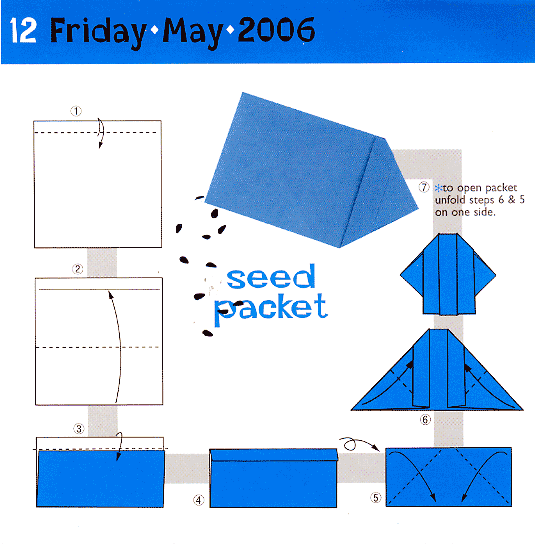
My novice origami skills.

Reverse Engineering Seed Packages

I also got together some of my seed packages to send to those who offered their help in lightening my seed load. My desire to use less plastic and spend less money meant I decided to make some little envelopes with scrap paper. Some of my seed trading friends from Europe send me these cute little packages so I attempted some reverse engineering. After various attempts, I think I got the formula. I really like this design because it is quick, pretty easy to open and close, requires no taping and, most importantly, the seeds stay put.

This appears to be the same design if you would like to try. My only suggestion is to use rectangles to start, instead of squares, by dividing a standard piece of paper into thirds envelope style and then fold that in half so you end up with 6 seed saving pouch pieces.

Tomorrow I'm going to try newspaper seedling pots.

* I'd mentioned Hablitzia tamnoides briefly the other day but it deserves more attention. A perennial, woodland climber and spinach substitute, it is a useful addition to the food forest. Read more in Stephen Barstow's article in the Permaculture Magazine.

Wednesday, February 23, 2011

Seed Starting - an irreverant primer

I am going to pause the exposé of rot to write something timely for us gardeners. Just when winter is at its bleakest, we open packages of promise and start to sow. My guide to breaking the rules.

Photobucket
Tomato plant ready for outdoor living.


1. Don't start your plants too EARLY!

No! Stop! Don't plant cucumbers now! It's bad! They might eat your house! Or at least scare the children with their weak, limp tendrils growing cave-light pale on your window sill. It's true, unless I had a fancy greenhouse, I wouldn't start cukes this early. It is way easier to sow in direct in the garden or to start in transplantable containers a couple weeks before setting out. However, I start strawberries in early winter and some plants need months of stratification to break dormancy so I sow them in the fall. This rule is mainly aimed at getting people in short season areas to start their tomatoes in April, or late March at the earliest, rather than in February.

I'll cop to planting tomatoes in February one year. You know, earliest possible last frost date of the beginning of May minus eight weeks gives you March so last week of February sounded reasonable. They did fine. The problem, as I see it, is if you are growing a tomato that tends to crop all at once such as determinates, then you might get a flush of flowers on your root confined seedlings, lowering your yield. There are even tomato varieties that are bred to withstand low indoor light, such as Red Robin, that will hopefully give you fruit in the dead of winter!

So when do I start seed? All year.


2. You MUST have indoor lights!

Indoor lights are good. It's like you have control of your very own sun. To get the maximum satisfaction out of them, I recommend having as many as you can afford in a compact space such as a tower, with the lights on a timer. The often quoted number is of light hours is around 16 but some people have them on round the clock whereas others claim that seedlings need nighttime. There is the question of plants who are sensitive to changes in day length but I'll leave that research for another day. Normally my seedlings get 12 hours because I have two shifts of trays. The lights should be about 2-3 inches above the seedlings.

Wimpy baby plants prefer things moist. I would suggest wick mats or some DIY instant water dispenser but then you might spend less time staring at your seedlings. The best way to avoid problems is early detection so stalk your plants!

You can use actual sun filtered through a window too. Most gardeners will tell you this is not ideal but it does work especially if you have sunny windows that face south(ish). However, I have had success overwintering perennial herbs like rosemary, bay and hot pepper in a north window.

What you really want is to give your seedlings the amount of sun that they have been adapted to thrive in, as soon as possible. When the weather is decent during the day (10C or more) I stick my seedlings along side my winter sown containers. This is just really early hardening off so I start with having them outside for just a little while, building up until the seedlings are hanging out in real sun most of the time. If they are cold hardy, I have probably wintersown them or planted them out already so this is really only for tender bedding plants.

If you have a season extension device like a greenhouse, polytunnel or coldframe then you can put your seedlings out sooner but remember to keep them slighly open on sunny days to avoid frying your plants. Also, outdoor containers will dry out faster than indoor ones.

Photobucket
Wintersown containers revealing seedlings in spring.

Wind is just as much of a shock to tender seedlings as real sun. Their stems were build to withstand the still, indoor air. To make them sturdier, you can set up an oscillating fan nearby or crack a window on nice days to let in the breeze. If my baby seedlings are going outdoors without the shelter of a greenhouse, I usually place them in a box with high sides to protect them from the wind until they have adjusted.

3. But what about the soil and the containers? TOO many choices!

I would suggest starting with the biggest size container that you plan on using for your plants. This will give you a better idea of how much space you need, disturb the roots less and be less work. As for what you use as a container, the world is your oyster as long as the pot has drainage holes (though I have been known to plant indoor seedlings in flats without drainage to keep in moisture longer but these don't go outside in the rain). For plants that resent root disturbance, such as melons, soil blocking, or compostable pots are probably ideal. Tap rooted plants like parsley need deeper pots than those with more lateral root growth like tomatoes. Plastic recyling day is when I get most of my seed starting paraphernalia. The pop bottle is a classic wintersown greenhouse but I also like yoghurt tubs for large seedlings, and fruit boxes to grow flats of seedlings.

As for soil, you could use your own if you are lucky enough to be able to thrust a trowel into it at seed starting time, or you could make a mix or purchase something. I admit to using whatever is available. My outdoor soil is often stickier than the fluffy, soilless stuff from the stores so dries harder. Mixes that are high in organic matter hold their moisture for a long time which is a benefit. I avoid mixes with fertilizers or other chemicals. If you are worried that your soil may contain organisms that might cause die back in your plants, you can cook your soil to sterilize it.

4. Seed starting is too HARD!

Nah. If it was then I would probably have given it up. Seeds are designed to grow so given the right conditions and a little attention from you, they'll do their thing.

Q&A for specific problems

  • Can't afford lights and don't have a southern window: Wintersow or half outdoor grow! Try it anyhow, you never know, it might work.
  • Cat eats the seedlings - Grow in a cage.
  • Seedlings always die off - A solution of hydrogen peroxide, garlic or other antifungal can help. Check the soil for root eating pests, sterilize soil and pots. Watch your watering level.
  • Seeds don't sprout - Look up the longevity of the seeds, maybe they're old. It's also possible that they require special conditions for germination including cold, heat, scarification (scratching the seed coat) or other pretreatment such as overnight soaking. Err on the side of caution with small seeds and surface sow. Some plants germinate better in light such as lettuce whereas others prefer darkness. Less cultivated varieties, including lots of herbs, often germinate erratically, over a long period of time. Try pre-sprouting to test seed quality or to isolate some seeds for special treatment. Peppers germinate much faster using pre-sprouting in a warm area.
  • Seedlings always look a bit sickly - If their colour is off then they might be suffering from nutrient deficiences either because their growth medium is lacking or because they are too cold. Correct with some compost tea or by placing somewhere warmer.
  • Seedlings have long, weak stems - This is usually caused by insufficient light. Try growing in a season extension device part of the day, wintersow, and gradually expose to air currents. When transplanting, some plants can have their stems buried such as tomatoes so they are less likely to flop over.
  • Plants never give me fruit / don't ripen properly even though I start them early - You might need to look for a short season variety of what you are growing or one that is more adapted to your locale whether that be foggy east coast or the blinding light and tumbling nighttime temperatures on the side of a mountain. Sweet potatoes started from tubers at the store will probably not crop well here but the cultivar Georgia Jet will give a good harvest most years. It is possible that the plant you covet just won't grow well in your climate, or your garden, such as tender biennial red beaded broccolis. I know, I want to grow them too.
  • But I really just don't want to start my own seeds - There are small growers that will provide veggie starts for you and lots of seeds that do best when planted in situ. Check with local seed suppliers.
My Seed Starting Schedule
- updated - I'll add division schedules at some point.

January
  • Sow plants that need 10-12 weeks headstart if they are set out before last frost or are erratic germinators. For example, violas
  • Sow plants that you are tricking into thinking are two years old. Ex. Globe Artichoke.
  • Wintersow frost hardy plants that prefer stratificaiton.
February
  • Alliums such as onions and leeks
  • Plants that need 10-12 weeks headstart but are set out in warm weather
  • Pre-sprouting hot peppers
  • Wintersown containers
March
  • Wintersow plants that don't take full frost
  • In mid-March, plants that need an 8-10 week headstart
  • Greens in polytunnel / season extension device
  • Near the end of the month, plants that need an 6-8 week headstart such as tomatoes, eggplants, sweet peppers, other solanum berries. Sometimes cabbage and broccoli starts as well if need a long season
April
  • More tomatoes and other plants that need 6 weeks heastart indoors
  • Cabbage and broccoli starts
  • Sow peas, radish parsnips in the ground
  • Cold season greens in polytunnel or in ground if it is warm and dry enough
  • Leeks and onion transplants in the ground with a row cover if cold
  • Near the end of the month, start sowing other root crops like carrot, oyster root
  • Start lettuce and half hardy greens and herbs in the garden.
  • Plant out 4 week out brassica starts
May
  • Last frost will be somewhere is somewhere near the beginning of May, watch the weatehr
  • At the beginning of the month, plant potatoes
  • Plant more broccoli and cabbage seedlings or seeds
  • Start long season melons, squash or other heat loving crops that need a month headstart
  • Direct sow into the garden squash and beans near the end of the month when the soil is warm.
  • All hot loving herbs and flowers can be sown near the end of the month.
  • Transplant solanums like peppers, tomato and eggplant into warm soil after last frost.
  • Can plant a second sowing of greens, or roots for baby vegetable production or succession sowing. I tend to harvest leaves rather than whole plants from greens so don't often do this.
  • Look for self sown seedlings to thin or transplant
  • Check your nursery bed for growth
June
  • Transplant melon, squash and sweet potato starts in warm beds
  • Start long season crops that will be ready for fall such as Brussel Sprouts.
  • Sometimes I sow a second crop of beans, summer squash about a month after the first and a second crop of peas.
July
  • Time to start thinking seriously about the fall garden. Start in a nursery bed or indoors starts of cauliflower, cabbage.
  • Sow into their final position tap rooted plants for fall harvest like carrots, florence fennel or coriander.
August
  • Sow quick growing greens in greenhouse or cold tunnel space.
  • Sow plants that you want to overwinter as seedlings like spinach.
  • Scatter ripe seeds of self seeders where you want them to grow.
September
  • Prepare and sow nursery bed in time for fall rains
  • Scatter seed from self seeders that appreciate stratification.
October - December
  • Plant garlic and other perennial overwintering onions or tubers like Jeruselum Artichoke.
  • Make sure all fruit seed and other seed that does best with moist stratification or oscillating temperatures are sown in mice proof containers before hard frost.
  • Wintersow in a sheltered snowing location that can take or prefer frost.


Photobucket
Self sowng salad ingredients.

Common Veggies & Herbs, tips

Amaranth - Likes heat so start in situ after last frost or give a short headstart. More from Salt Spring Seeds about Amaranth and Quinoa
Basil - Needs heat and warmth to grow well. Start early only if you can provide these two requirements otherwise start using the half outdoor method or in situ. They grow well from seed planted in warm soil.
Beans - They do not tolerate frost. Plant after soil is warm and after last frost. For staggered harvest, try some early bush types along with some pole beans.
Cabbage - There are short and long season varieties. I find that this technique works best for me. Can either be sown direct into the garden or started as transplants. They grow and head well in cooler weather.
Carrots - Can be planted anytime that the soil is moist and there is no hard frost but ensure that you have enough growing time for them to bulk up. They don't germinate well in the dry soils of summer. I normally start my first crop in late April.
Cauliflower - Best grown as a fall crop here. Start in mid-summer for fall maturation.
Chicory - To get the classic head, these are grown as fall crops but they are perennial so sow and let grow.
Chinese Cabbage - Another veggie that bolts in hot weather. I usually have some that have overwintered and self seed. Another crop best grown to mature in fall or in the polytunnel/coldframe/greenhouse. Coleman's Four Season Garden is a great resource.
Chives, garlic and normal - These are perennials which can be started very early in spring or can be sown direct in the garden. If it can be started outside, I usually do. It's just easier.
Coriander - There are varieties that are grown for seed and some for leaf. Longest leafing plants, for me, were grown in part shade in moist soil. Will bolt in hot weather. Seed every few weeks for a more continuous harvest. Will self seed.
Corn - Plant in situ after last frost.
Dill - Frequent self seeder. Plant at the same time as carrots.
Eggplant - Started around the same time as tomatoes and planted out after last frost. Not a thrifty plant: needs heat, moisture and fertility. Give it your sunniest, warmest position here in the north. It helps to prewarm the bed with clear plastic or incorporate half rotted compost/manure nearby. Variety is imoprtant here too. Choose a short season one. Some of the long asians and applegreen have both cropped well for me.
Fennel - Florence or bulbing fennel is another great candidate for the fall garden so start in summer to mature in the cooler part of the growing season.
Garlic - Plant this after first frost but before ground is frozen. You can grow garlic from the bulblets that develop at the top of the scapes but it will take a couple years for them to bulk up.
Kale - It is quite possible to get a self seeding population of kale around here. Choose a hardy variety and seed two years in a row as they are biennial. The seedlings are normally up and growing by late spring. I would direct sow these.
Lettuce - Succession sow whenever there is no hard frost. Choose varieties that are suited for different times of the year. Often lance leaf open types do better in summer whereas the cripser heads bulk up better in cool weather.

Mustard Greens - Lots of varieties have excellent cold tolerance but bolt quickly in the heat. I let mine go feral and eat when available in the spring and fall.
Melon - Will not take any frost. Choose short season varieties and put into prewarmed beds with either manure or plastic (see Eggplants). You could capture even more heat by building a frame that angles south for the vines to scramble over. These can be prestarted in transplantable pots several weeks to a month before setting out.

Oyster Root - Salsify is the biennial and Scorzonera (I recommend) is the perennial with edible root/leaves. Sow at the same time as carrots.
Orach - These should be self sowing in your garden given half the chance. Start in warm, wet spring. Can also be fall sown.
Onion - Start in February, transplant out to the garden after hard frosts. I usually put mine out sometime in April.
Peas - I plant as soon as the ground can be worked but I've been chastised by growers in climates with heavy, wet soil saying that their peas would rot if planted too early in spring so use your conditions as a gage. Plant when the soil is 'workable.' Plants grow best in cool weather. I often grow a fall crop mostly for the edible green shoots.
Parsley - Some people suggest presoaking to speed up germination which can be slow and erratic. You can start this one inside but it grows well when sown in situ in spring. To be honest, I've only started this plant a couple of times as it was a very good self seeder for me.
Parsnips - I love parsnips so much. I plant these as soon as the ground can be worked in the spring.
Peppers, hot - I presprout these in February and grow under lights in a warm place. Plant out after last frost.
Peppers, sweet - Presprout and grow in March with Eggplants.
Potatoes - I'm a novice with True Potato Seed (TPS) Here's someone who knows more. Tubers can be planted a week or so before last frost.
Potato Onions, Walking/Topsetting Onions - If it can overwinter in the ground, plant in early fall.
Radish - I always forget about this veggie as I'm not a fan but I do sprinkle them around the early spring garden.
Spinach - Cold season crop great for fall, spring or polytunnel gardens. Direct sow.
Squash - Choose a shorter season variety though with about 120 frost free days, we have lots of choice. These are planted after last frost in warm soil. You can use transplants as in melons.
Sweet Potatoes - Grown normally from slips produced by the tubers, they should be planted in the warmest, sunniest part of the garden. See Eggplant.
Swiss Chard - I half outdoor grow these or start in situ in late spring.
Tomatoes - Start about 6-8 weeks before last frost which is the end of March/April. Stems can be partially buried if you have a floppy plant, set deep or plant diagonally. Try wintersowing short season or sauce varieties too.
Watermelon - See melon.
Other - Want info on a specific odd ball veggie I've mentioned in the past, please email or comment and I'll add it to the list or maybe I'll make another list?

* Half outdoor sow: I set outdoors during the day while warm (usually above 5C if under a ventilated cloche, otherwise when over 10C or so) and inside at night. I start to do this in late March/ early April.

Daphne's Dandelions writes a great post on seed starting

-- edited to add --

I Wet My Plants - Great Kemptville Gardener that I have the pleasure of bumping into during Seedy Days and other garden festivals has put up a couple posts on seed starting including a seed starting calculator.

Sowing Seeds, including difficult plants by JDHudson

Monday, February 14, 2011

Happy Heart Day

Photobucket
I did not grow this potato but I love it nonetheless.

Love --> Little Ones

I am a seed maniac which leads to seedlings and then, all going well, to plants. Now that I have an acre plus clearing to fill with greenery, I have been seed starting mad. There will be two shifts under the lights soon and the southern windows are getting full. But heck I'm having fun. There are lots of perennial herbs, alpine strawberries, and onions crowding for space. Lots more seeds are stratifying and even more seeds waiting to be sown. It's going to be a crazy year!

Photobucket
Some onion seedlings crowding their container.

For those of you in need of seed, Seedy Saturday in Ottawa is being held at the Ron Kolbus Lakeside Centre on March 5th between 10am and 3pm. I plan on being at the trade table with all my extras. Hope to see you there!

P.S. I didn't forget. The next installment of composting will be out next week for those that were waiting to read more about rot.
P.P.S Does anyone know this blogger error? bX-y67gro

Wednesday, January 5, 2011

What to do with too many seeds!

I have a lot of seeds.

No, really: A. Lot.

Partly because I was moving last year so I couldn't garden as much as usual, partly because I was in collection mode for my new larger digs, partly because I have lots of generous friends, partly because I won't throw out seeds, and mostly because I love gardening.

I can live no longer with so many unsown packages of promise! Thinning has commenced.

Step 1: Really old seed that will probably not pass the germination test is being tossed into my new garden compost pile. Maybe some of it will germinate and if so YAY! If I recognize the seedlings, they will add to the garden with no further effort from me.

Step 2: Anything that is marginal for germination and an edible green is going into my indoor salad bed.

Photobucket
Ancient peas and spinach that might be as old as my youngest child (5) sprouting along with the fitful starts of short lived orach seed.

Step 3: Bags of left over nitrgoen fixers such as lentils, beans and so on (where did these things come from?) and other quick growing bulk plants are going to be sown when appropriate as green maure.

Step 4: Anything that can handle cold stratification (or prefers it) has either been fall sown in the garden or is to be wintersown in containers. I have retained some precious seed for more controlled germination but the rest is OUTSIDE.

Photobucket
The first set of wintersown containers. These are what I like to call deep wintersown. I have other seeds that I'll start later, sometime in February or March.

Step 5: If I don't want it / have extra and it will probably pass a germination test, it is up for trade. Any remainders will appear on the Seedy Saturday trade table or be donated.

Phew done for now. Still too many seeds. Maybe I'll try some weird tomato growing experiments. Can a tomato grow in the shade, on a rock, in a tree, on a boat, with a goat, eating green eggs and ham.

Order will be restored.

Tuesday, April 6, 2010

Tomato Tuesday*

I missed Harvest Monday so I thought I would make it up to you by showing how my outdoor/indoor tomato start project was going. To be brief, this is a technique I use for frost tender seedlings. It is similar to wintersown though I originally thought of it as an alteration of coldframe techniques but enough quibbling over 'sources.'

Photobucket
Bouncy baby tomato plants

I make a 'wintersown' container and plant in seeds like tomatoes or pumpkins or something that would not be thrilled by frost. Then instead of just leaving them outside, I put them out only on warm days (approximately above 4C) in their mini greenhouses. The cover comes off it is above 10C. At night, I bring them in. Post one, where I make the container - Really Easy Seed Starting. Normally the seeds germinate quickly in warm weather but this one was languishing so I did a germination test on the seeds I used and they FAILED (old package of old seed from an old organization - keyword folks). I presprouted another short season tomato variety and planted when I saw the first root. That was a couple days ago now so here we have plants. Normally I don't have to presprout anything that volunteers in the garden like tomatoes or pumpkins but you gotta do what you gotta do for those juicy globes of tomato goodness.

Speaking of warm weather. Who wants to make bets on no frost for April in Ottawa?

Photobucket
Spring is official: Watch out for the attack of the fuzzy, mud monster.

* I didn't think Tomato Tuesday was a real thing but I googled to be sure and you get lots of hits.
** There is so much going on in the garden that I might do an update post soon. Yeah, I know there were no other footnotes mentioned but I just thought I'd throw one in anyhow. Garlic is an appreciable size, alliums spears poke out everwhere. Crocus, winter aconite, recticulated iris, scilla and more are in bloom. I even so the red shining through the buds of early tulips. Seeds of kale, mustard and other greens have sprouted. With this weather, we should be lush and multicoloured in no time. The browns and greys of early spring are behind us now. Full speed into summer!

Friday, March 12, 2010

Really Easy Seed Starting

This is a post for a friend who will be balcony gardening this year. It's a simple technique for starting tomatoes if you just don't have any space. Some of you will recognize this as a variation on wintersown.*

***

Cat eating your window ledge tomato starts? Want to give your squash seedlings a head start but don't have any more space under the lights? Plants always die on you because you don't have time to harden off? Plants don't perform as well as you would like with regular wintersown techniques?

I like to call this the Indoor - Outdoor technique and I plan on taking pictures of it to the end - whatever that end might be. I have had success so far.

Photobucket
What's going on in there? My eldest looks in the bottle mini greenhouse/planter.

Cherry Tomato Starts*

Step 1: Get a plastic jug or pop bottle and poke holes for drainage at the bottom. Cut in half. You can cut some windows in the side for further ventilation later.

Photobucket
Juice container with being pierced with a metal BBQ squewer

Step 2: Put seed starting mix / dirt in the bottom half. Water well. Put in some seeds


Photobucket

Step 3: Replace the top by squeezing in a bit at the sides. There are other ways of doing this, check out wintersown for more ideas of containers and techniques.

Step 4: Put outside during the day when the temperature is above 4 C. This is why it is best to start around April 1st but this year, with the unusually nice weather we've been having, I started now. However, for vining starts like squash, I'd wait until at least mid-April if you are planning on putting them out mid to late May. Later if you aren't planting out until June.

Photobucket
Yes, those are some violas started this way already up and growing.

Step 5: If the day is especially hot, open up slightly for more circulation. Entirely remove the cover if seedlings have been exposed to wind for a few days. You can also place seedlings in a box so they get less wind. If very warm, you may also want to put them in a lightly shady spot (if possible) while you are at work all day.

Step 6: Take in your planting bottle each evening unless the night temperatures are above 6C (margin of error for frost). Remember to water frequently if it has not rained or is sunny.

When the seedling is between 6-8 weeks old and danger of frost is passed, you can plant in final location. In Ottawa this varies from mid May to the beginning of June.

More pictures to come as project progresses.

Have fun!

* Tomatoes, squash can quite easily be started using regular wintersowing techniques. I like this method because I find frost tender plants get a bit bigger. I sometimes also germinate seed indoors and then give them the indoor / outdoor treatment from when they are tiny seedlings so they don't spend any time under lights but they are jump started into growing before nighttime temperatures would be conducive to that.

So feel free to just sow and leave them outside. That'll work too. You may have to water on occasion during dry weather.

Thursday, January 21, 2010

Wake up Sleepy Seed

On Dormancy and Breaking it

Photobucket

Ssh: This is all a (hopefully) informative ruse to remind you about wintersown but pretend you didn't read this. Some seed sown outside in the snow.

Since I am stratifying some special Angelica seeds that I just received by mail, I thought it would be fun to write a bit about seeds and dormancy.

In the veggie garden world, we often don't think too much about seed dormancy, because our tomato seeds spring into active growth as soon as we 'add water.' I've seen bean and squash seeds sprouting when still on the vine if left to over-mature in rainy weather. The obligatory nature of most crops is useful to the gardener as it means that the plants will uniformly sprout in a predictable amount of time. If you have tried your hand at starting herbs or perennials from seed, you have probably found that not all plants are as easy-going. Some, like parsley, can take several weeks to sprout. Others, like rosemary, sprout erratically over a long period of time.


Benefits of Variability

It serves us to have our vegetables be reliable germinators, but it doesn't always benefit wild plants to germinate quickly and all at the same time. It makes more sense to have your seedlings sprouting only after certain conditions are met such as undergoing a cold spell, breaking dormancy when the soil is wet, in a certain temperature range and when exposed to light. This will ensure that plants, for example, emerge in early spring when the tree branches are still bare and lots of light hits the forest floor. Also, if seeds germinate at different times than they might miss the slug mower or unseasonably cold temperature that wipes out the first batch.


Seed Life

The seed coat has to be strong enough to protect the embryo inside, and prevent excessive moisture loss. It is easy for us to think of seeds as not quite alive but it is more accurate to say that they are hibernating. How long the seed can live varies between plant types with some only remaining viable for a couple months and others surviving many years. For example, amoung vegetables, members of the carrot and onion family tend to have shorter lives than those in the cabbage family. Heat, moisture and light may all cause the metabolism of the seed to speed up, shortening its shelf life. This is why most seed is stored in cool/cold, dark, and dry place. Exceptions to this are seed that must remain moist to be viable such as water plants,* or to prevent the seed from going into a deep dormancy that is difficult to break.**


Sprouting Seeds

To get a seed to grow, the embryonic plant needs to be watered. Some seeds readily let in water but others have hard seed coats or are coated in residues designed to stop germination while still inside their wet fruits such as tomatoes. The gelly or coating has to be washed off with sufficient water before the seed can germinate.

Scarification: Sandpapering, nicking or otherwise damaging the seed coat but not the embryo to let in water.
Often a seed coat will be so hard that it has to be damaged in some way to allow water to enter. This can be from being chewed on or from soil grains scratching the seed or some other process that the plant has evolved to rely on. In our home gardens, we deal with seeds that need a bit of help breaking through their seed coats by using sand paper or nicking them with a sharp knife. Soaking them over night in hot water is another trick commonly used with plants such as sweet peas.

Hot Water Treatment: Soaking some seeds in hot water can soften seed coats and remove germination inhibitors.
Just like with other characteristics of many plants such as flower colour, leaf form etc..., seed coat thickness can also be variabile leading to variable germination times. I have had NO luck starting strawberry spinach, Chenopodium capitatum, but had heard that it can self sow freely. So instead, I bought a couple plants and told them to do their thing. Later, when visiting Wild Garden seeds, I discovered that they are known for erratic germination because of variable seed coat thickness. They have worked at domesticating this seed so it has more uniform germination.

Stawberry spinach also has tiny little seeds that should be surface sown as they germinate better when exposed to light. This is true of other common vegetables such as lettuce. How much light, and what kind, a seed is exposed to gives it information such as far from the soil surface they are. Small seeds don't have as much stored energy to grow through the soil which is partly why they are not sown as deeply as larger seed such as beans.

Some seeds require light to germinate so should be surface sown - pressed into the soil surface rather than buried.
The other common requirement is cold treatment or stratification. Not surpringly, this is found in plants that are native to temperate regions that have winter. North american wild flowers, trees, and many cold hardy perennials germinate better when treated this way.

Stratification: Sticking seeds in a moistened medium in a cold place like your fridge for a period of time to simulate winter.

Which brings me back to those special Angelica seeds that I received that are in the fridge pretending to be in wintertime. You might be asking yourself why I have to pretend at all because there is at least a foot of real snow on the ground right now. These are such special seeds that I have also sown some in a pot outside buried in the snow but to hedge my bets the rest are in so-called controlled conditions in my fridge.

Winter-sowing - Wintersown

Which brings me to the real point of this whole post. Any remember to do their winter sowing? This is a great technique made popular by Trudi Davidoff. Using recycled containers, she makes them into little greenhouses in which she pots up seeds and puts them outside in the snow. They stay out there, unattended, until they the hardy little seedlings are ready to be planted out. No lights, no mess, usually no watering or maintenance until warmer weather comes, no hardening off and more space to start other plants inside. People even wintersow tomatoes!


Photobucket

Red iceberg wintersown lettuce waking up - 2009.

*** More Links ***

* Water plants and seed storage, as well as lots more info on Seed Storage at Mother Earth News
** Ephemeral Seed - info from the Alpines from Seed page

Fun Facts on germinating Carnivorous Plants - a pictorial demonstration of simulating fire
Wintersown.org - the official site
How to stratify seeds by Canadian Gardening
Much More on Seed Dormancy for those that really want to know